


Spring Atlantic Salmon Fishing: Mastering High Water on the Kola Peninsula

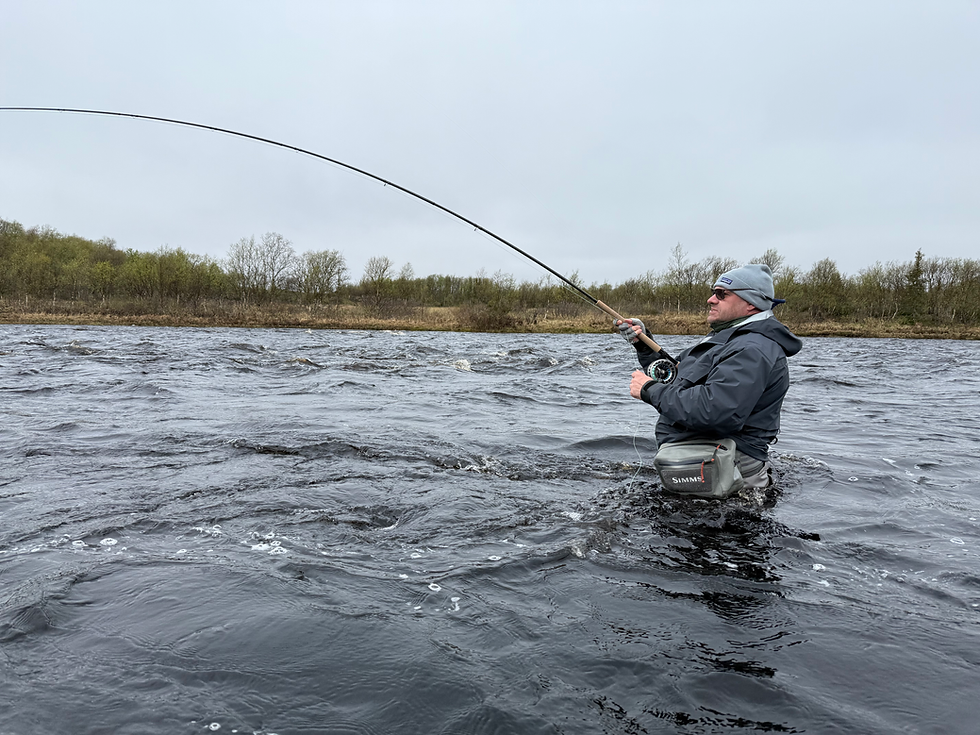
Only three months remain until the spring salmon season opens on the Kola Peninsula — one of the world’s most legendary destinations for Atlantic salmon fishing. Now is the time to check your tackle, sort through your fly boxes, and seriously think about strategy.
Here in Chavanga river lodge, every season, we spent one or two weeks battling high water levels. We love a bit of a challage that can be highly rewarded for us and many of our guests. On rivers of White Sea there is a big run of fresh fish coming into the rivers in Autumn period, so all those fish are still in good condition in early season while the water is still cold and high.
In my view, all preparation for Atlantic salmon fishing in spring can be reduced to solving one key problem: how to fish effectively in high water. Everything else is secondary.
Water temperature, clarity, fish activity, and even the number of salmon entering the river can vary dramatically. But one factor remains constant during spring salmon fishing on the Kola Peninsula: high water conditions.
High water:
Limits the number of accessible fishing spots
Restricts our ability to move and take advantageous positions
Makes reading the river far more difficult
Unpredictably changes Atlantic salmon migration routes
Dramatically increases water volume, reducing fish concentration
Creates technical challenges in rod and line control
When preparing for Atlantic salmon fishing in high water, we should focus only on the factors we can control — our technique, tackle selection, and tactical decisions.
During the cold, flooded rivers of early season, here on Chavanga river, salmon tend to hold close to the bottom, avoid heavy currents, and rarely respond to surface presentations. That means our primary task is simple: present the fly deep and fish it slowly near the bottom.

Getting the Fly Down in Spring High Water
The first step is choosing tackle that allows you to deliver the fly close to the riverbed.
There are four main approaches:
Use a heavy sinking line with a heavy fly
Use a heavy sinking line with a standard fly
Use a heavy fly with a floating line
Apply specialized presentation techniques that help the fly sink deeper
Choosing the correct option — or combination — often determines success during the spring salmon season.
Based on experience in high water Atlantic salmon fishing, I suggest two guiding principles when selecting your setup.
1. When You Cannot Clearly Locate the Fish
On large rivers typical of the Kola Peninsula, we often cannot immediately identify where Atlantic salmon are holding. In this case, we must systematically cover water — step by step — fishing through wide pools and long runs.
Technically, this is easier with a standard fly on a sinking line. Casting is simpler, distance is easier to achieve, and you can effectively fish large areas. This approach works especially well on wide pools where covering water efficiently is critical.
Often, this is how productive lies are discovered. Strikes begin to follow one after another. The reason for the concentration of Atlantic salmon may not be obvious in spring. Later in the season, we may discover local holes, submerged rocks, or subtle bottom structure that attracted fish during high water.
2. When You Know the Structure
If you already know the river — perhaps from previous seasons on Kola Peninsula — you can narrow your search and avoid wasting time on unproductive water.
In this case, a floating line combined with a heavy fly is often ideal. The floating line makes casting and fly control easier, while the added weight of the fly allows it to reach the holding depth.
Here, you are not searching broadly. You are targeting a specific lie — a known holding position for Atlantic salmon in high water.
A Practical Tip for Spring Salmon Fishing
For fly anglers who have not yet mastered heavy sinking systems, here is an important consideration:
In spring salmon fishing, casting distance is critical.
When rivers on the Kola Peninsula flood, wading opportunities are limited. Standing on the bank, you can only reach a small portion of the river. If distance is a challenge, it may be wise to sacrifice some line density or fly weight in order to cast farther from shore.
A long rod, a floating line with a sinking leader, and a moderately weighted fly often provide the best balance between distance and depth.
Presentation Techniques for Fishing Deep
If you can vary your casting technique, several simple methods will help an unweighted fly reach greater depth — an essential skill in high water salmon fishing.
Upstream casting elements or slack line casts. These presentations allow the fly to sink deeper in the target zone.
Upstream mending combined with slack line. An upstream mend slows the fly’s downstream movement. With reduced tension, the fly gains additional time to sink deeper before tightening.
A downstream mend, on the other hand, accelerates the fly across the current. This can sometimes trigger aggressive takes, but it is more effective when fishing with sinking lines and covering large areas.

Conclusion
Successful Atlantic salmon fishing in spring — especially on the powerful rivers of the Kola Peninsula — largely depends on two abilities:
Being able to adapt your fishing to high water levels. Cast far. Fish deep.
Everything else — water clarity, temperature, fish numbers — plays a role, but technique and tactical adaptation to high water conditions remain the foundation of consistent success during the spring salmon season.


Comments