


To Fish or Not to Fish: Should Guide Carry a Rod?
- Vasil Bykau
- Jan 14
- 6 min read


There are many opinions—and even formal guidelines—about what a fishing guide should and should not do: how they should behave, how they should look, what they should say, and even what they should drink. At Chavanga Lodge, a fly fishing lodge on a remote salmon river in the White Sea region, we have also developed our own internal rules. As I see it, they differ noticeably from those adopted by large, well-known salmon fishing camps.
Historically, our approach to guided salmon fishing evolved in relative isolation from the standards established in the major camps of northern Kola. The eastern part of the White Sea was once truly wild territory, and it is quite possible that local conditions on this remote salmon river in Russia forced us to remain flexible in how we organize fishing. Here, however, I would like to focus on one specific question that has repeatedly come up in conversations with guides from other well-known salmon rivers:
Should a professional fishing guide fish on the river, or should they remain without a rod?
Sooner or later, this topic arises in the relationship between guide and angler. It is not straightforward—there are different, often categorical opinions—which means the subject probably deserves a proper scientific study. For now, let us look at both sides: first, the arguments in favor of “YES, a guide may fish”, and then the arguments for “NO, guides should not fish.”
Arguments in Favor:
YES, a Guide May Fish
Knowledge of the River Comes from Practice
A good professional fishing guide must know the river, understand fish behavior, and know how to catch fish consistently. This experience is exactly what the guide is expected to pass on to the angler during guided fly fishing trips. That much is obvious and rarely disputed.
Experience cannot be bought, borrowed, or learned elsewhere. It is acquired only through daily work on the river—especially on a wild Atlantic salmon river, where conditions change constantly.
This is where the difference becomes apparent between a guide who stands on the bank and one who wades in the water. Old jokes from books and videos about the difference between a ghillie and a guide come to mind. The reason is simple: river conditions on Atlantic salmon fly fishing rivers are variable and often unpredictable. Rain, heat, fluctuating water levels and clarity, and even the influence of the sea all add chaos to our understanding of salmon behavior.
Much has been written about this, but applying theory in practice is often difficult. To give sound, practical advice—rather than speculate about hypothetical scenarios—a guide needs firsthand information about the river. A clear example of the first step is reading the river: understanding the bottom profile, depth changes, and structural anomalies. Some of this can be seen at low water, but most essential information is gathered with one’s feet while fishing.
Anglers’ reports can help, but they are often subjective. Usually everything boils down to fly choice or pool selection, which is rarely enough for consistent success on a remote fly fishing destination. Choosing the right strategy and tactics is easier for the guide, and sometimes this requires picking up a rod and testing assumptions in practice. Whatever one may say, only a hooked fish truly confirms the validity of advice.
Demonstration of Technique
Demonstrating casting or fishing techniques is often useful and sometimes essential. Anglers arrive for Atlantic salmon fly fishing holidays with very different skill levels, and for many, salmon fishing remains something exotic.
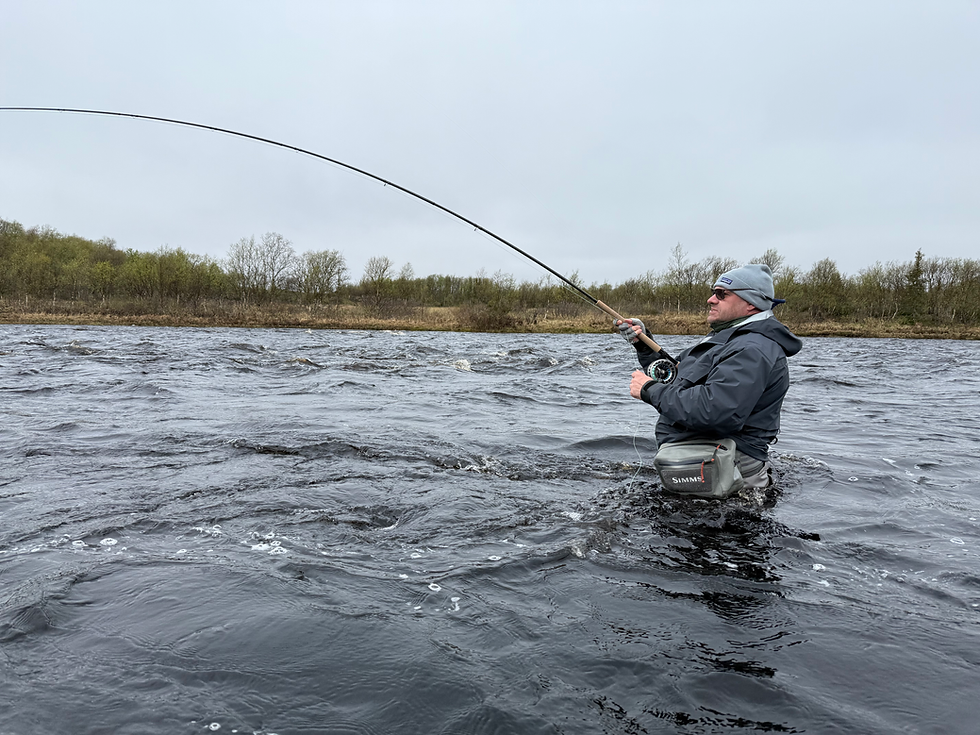
Limited experience—and occasionally a language barrier for European guests—means that a visual demonstration becomes the fastest and most effective teaching method. By positioning themselves in the water and working the rod, the guide shows how to act: where to enter the water, how to take position, how to determine casting distance and angle, and how to move through a pool.
For a beginner, even simple actions on a salmon river in Russia can feel overwhelming. Even experienced anglers often feel uncertain on an unfamiliar river. The task of a guide with a rod is to demonstrate correctly and ensure everything is understood. Fishing side by side, when conditions allow, often accelerates learning and correction of mistakes.
Quick Assessment of a Pool
Sometimes a guest fishes through a pool without a single take, while the guide believes the pool is good and holding fish. In such cases, the guide may enter the water to verify whether their assumptions about pool choice or technique are correct.
The goal is to quickly identify the problem on the spot and offer a solution—change the fly, adjust the presentation, or move to another pool. This kind of “control fishing” is especially valuable on exclusive fishing beats with many pools, where decisions must be made efficiently to make the most of limited time.
Results as a Teaching Tool
A guide’s own result can be a powerful factor in persuasion and learning. When fishing is slow, anglers often default to moving from pool to pool, blaming inactive fish. This is understandable, especially on large rivers with many pools close together.
However, long-standing habits and fishing stereotypes often prevent anglers from adapting. Imagine a salmon angler accustomed to early-season fishing in cold, high water who suddenly encounters an autumn run, when water conditions and fish behavior are entirely different. In such moments, a careful, respectful demonstration with a rod can help overcome resistance and confirm the presence of wild Atlantic salmon.
Shared Fishing Experience
Fishing together can also make the experience more enjoyable. During small-group guided fishing, friendly relationships often develop between guide and guest. Conversations on the riverbank revolve around fish, food, and travel, followed by shared dinners and discussions.
A guide standing idly on the bank can eventually feel awkward. Often, guests themselves invite the guide to pick up a rod. When done respectfully—without interference—this shared experience can make the day more engaging and rewarding for both.
Immediate Information Matters
On remote salmon rivers, real-time information is critical. During autumn salmon runs, it is difficult to pinpoint exact holding areas. Some fish move quickly; others stop in unexpected places.
On rivers with dozens of pools, guides and guests must constantly adapt. Sometimes famous pools fall silent while neighboring ones turn into unexpected hotspots. This mosaic distribution of salmon appears almost every year and remains difficult to explain fully.
In such cases, experienced local guides may fish alongside guests to gather information. The results are then used to plan future fishing days and improve the overall quality of guided salmon fishing.

NO, Guides Should Not Fish:
There are also clear situations where a guide with a rod can do more harm than good.
Anglers arrive with different expectations and traditions. Some believe strongly that a guide should never fish. These views must be respected. If an angler feels uncomfortable, the guide should leave the rod behind and focus solely on support and supervision.
A guide also has many responsibilities: positioning anglers, monitoring safety, managing time, preparing meals, and ensuring smooth logistics at the fly fishing lodge. Fishing without necessity risks distraction and unnecessary pressure on the river.
Psychological comfort matters as well. Many anglers are mature, experienced individuals who may react negatively to a didactic tone. Demonstration should never undermine the angler’s confidence or position.
Most importantly, a guide must never fish water intended for the guest. On prime pools with guaranteed opportunity, fishing by the guide provides little useful information and only disturbs fish—especially on unpressured salmon water, where conservation and catch-and-release salmon fishing are priorities.

Conclusion
The absence of rigid rules governing guide behavior has both advantages and disadvantages. Strict regulations bring order, especially in large operations. Flexibility, however, often allows better adaptation to changing river conditions—something especially important on remote fly fishing destinations.
Bill Bryden once noted that repeating the same actions while expecting different results is a sign of madness—and that many salmon anglers suffer from this condition to some degree. It sounds like a joke, but there is truth in it.
Fishing stereotypes are often the reason for failure on the water. It is reasonable to assume that a guide with a rod in hand has greater influence over our imagination—and, in the right situation, a better chance of improving the final result of Atlantic salmon fly fishing.
What do you all guys think about it? I would be exremelly greatfull for your thoughts and feedback.


Wishing you all an amazing 2026 season!


Comments