


How I Caught My First Atlantic Salmon on the Chavanga River
- Vasil Bykau
- Mar 17
- 6 min read


In the beginning there was… no, not the Word. In the beginning there were two years of solo trips to the rivers of the northern coast of the Kola Peninsula.
The well-known public rivers — Pechenga, Titovka, Ura, and Kola — were whipped by my fly line from top to bottom without a single take. Surprisingly, this didn’t discourage me. A sudden love for the Arctic had already taken hold of me, and with a wide smile on my face I kept swinging the line, simply enjoying the wild beauty around me.
But everything has its limits. After two years of this platonic relationship with the North, I started craving something more tangible — even a small salmon would do. And preferably an Atlantic salmon, not a pink salmon.
So in the third year I decided to stop relying on luck and place myself in the hands of professionals. That decision eventually brought me to the Chavanga River.
Looking ahead, I can already say that I’ve been back three times since that first trip. What follows is mostly a story about the emotions and impressions I experienced there, along with a few practical notes on gear and flies that may be useful for anglers like me — enthusiasts rather than professionals.
Learning the Basics — Properly
The professional whose hands I ended up in belonged to Vasily Jr.
On the very first afternoon we walked to a pool not far from the lodge, where he gave me a short but very informative introduction. He explained where salmon tend to hold, how to present the fly, and how to properly work through a pool.
It took me about thirty minutes to realize one simple truth:
For the previous two years I had been fishing in the wrong places and in the wrong way.
Encouraged by this revelation, I went to bed that night with great anticipation. The next day I was about to meet my first Atlantic salmon.
Running for Salmon
The next morning I learned that my first salmon apparently lived about 5–6 kilometers from the lodge.
Later I discovered that salmon actually live all along the river. The daily ten-kilometer hikes were simply Vasily Jr.’s preferred style of guiding.
Personally, I had no problem with that. I was hoping to lose two or three kilograms during the week.
Unfortunately, that plan didn’t align with the goals Elena, the lodge hostess, whose mission seemed to be ensuring that every guest left the lodge a couple of kilograms heavier.
In this particular battle, the victory clearly belonged to Elena. With food that good, there was simply no other possible outcome.

A Few Practical Notes About Gear
When we finally reached the pool (and I should note that Vasily runs rather than walks, unlike most normal people), we started setting up the rods. This seems like a good place to share a few practical tips about fishing this river.
Layered clothing
You’ll be walking a lot and the weather can change quickly, so wearing multiple layers is the best way to stay comfortable.
Wading boots
Felt soles are essential, but studs are highly recommended. I didn’t have them on my first trip, which cost me a broken rod after slipping on a clay bank. The following year I came prepared with studs — and, I must admit, felt a certain satisfaction when my partner without studs ended up taking a brief swim.
Wading staff
Bring one. Guides may say it’s unnecessary and demonstrate how easily they cross the river without slipping. Don’t fall for it.
They know every rock in the river, while guests crossing the current often perform unexpected acrobatic maneuvers that leave the guides genuinely puzzled.
My First Atlantic Salmon
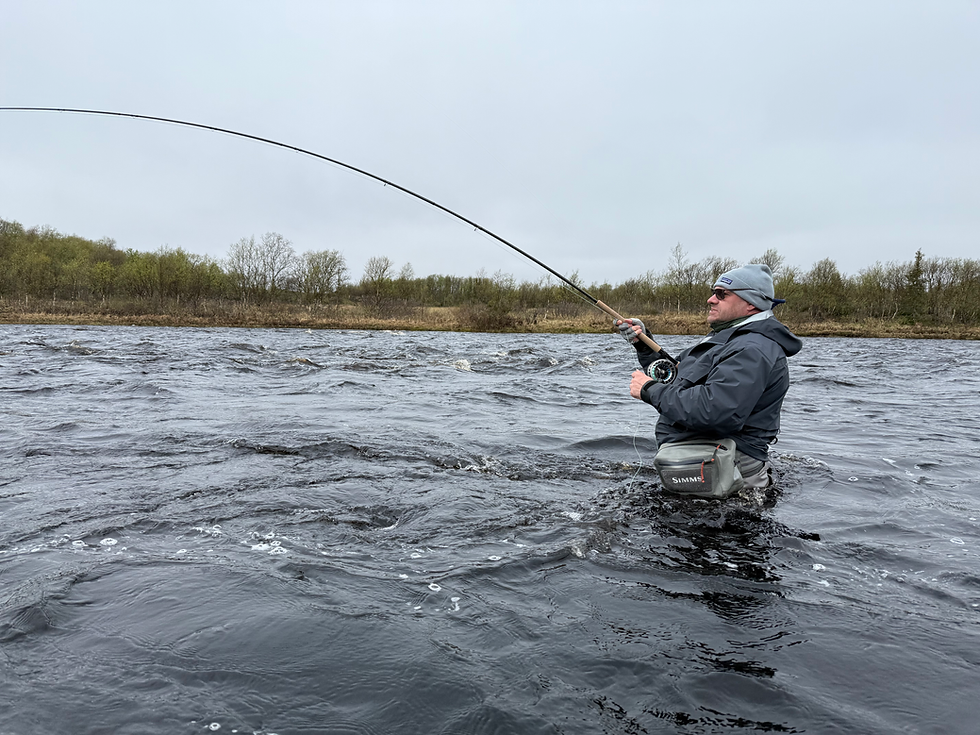
Standing in position, I began working my way down the pool, casting at about 45 degrees downstream and mending the line exactly as Vasily had instructed.
Then it happened — a solid take.
A small salmon, around 2–2.5 kg, suddenly came to life, jumping and making short powerful runs.
It’s difficult to describe the emotions of that moment. The fish wasn’t bright silver but an autumn fish, and certainly not a trophy — but it was my first Atlantic salmon, and that alone made it unforgettable.
The First Week’s Results
By the end of the week I had landed seven salmon, the largest around 3.5 kg.
Not an extraordinary result — except for one important detail.
Remember the salmon season of 2024. Across Norway, Sweden, and the northern Kola Peninsula, fishing was extremely slow.
Considering that, my only conclusion is simple:
Thank you, Chavanga.
My first visit took place during the third week of June 2024. Water levels were still relatively high, and not all summer pools were accessible yet. But the beauty of this river is that its many fishable runs make it productive throughout the entire season.
High Water Rewards
I returned twice in 2025, this time during the last week of May.
The river was running very high, but thanks to the guides’ advice I was well prepared. And the high water brought some excellent fish.
During that week eight salmon were landed, measuring 74–82 cm (roughly 4.8–6.5 kg). From what I understand, that’s above-average size for Chavanga.
Tackle and Flies
Most of my fishing was done with an 8-weight double-handed rod (13’3”) using either a floating Scandi line or a floating Skagit shooting head, always combined with a sinking leader.
In my opinion, fully sinking heads are unnecessary on this river.
Since I’m not particularly fond of tube flies, I fished small double-hook flies, even in higher water.
The most productive patterns were:
Red Butt
Golden Killer
Other reliable flies included:
Green Highlander
Blue Charm
Ally’s Shrimp

Trust Your Guide
One of the biggest lessons I learned on this river is simple:
Trust your guide.
One day was particularly hot, and I hadn’t seen a single take all day. I had already lost hope, but Vasily insisted that I step back into the same pool and cast into a very specific spot.
A few casts later — fish on.
Another example happened during an autumn trip in 2025. My fishing partner and I had been struggling for hours without success and had essentially given up, simply enjoying the spectacular autumn scenery.
Our guide Evgeny, however, clearly wasn’t satisfied with that outcome.
He picked up the rod and hooked a good salmon within ten minutes.
Our confidence returned instantly, and soon both of us landed fish as well.
When the Guide Fixes Your Tackle
On that autumn trip I expected my main rod to be an 8-weight switch rod, but in reality I only used it once — during a day of hurricane-strength wind when a Royal Wulff Ambush line proved very effective.
Most of the time I fished a 7-weight single-hand rod.
Unfortunately, I rigged it with a poorly designed leader, which combined with my imperfect casting almost completely destroyed the elegance of fly casting.
Evgeny, apparently unable to tolerate such abuse of fly fishing, began cutting and rebuilding my leader until it finally started to turn over properly.
My Brief Modeling Career
Later I realized that the artistic nature of both Evgeny and Vasily probably comes from Vasily Senior (dad).
In the evenings after fishing, during a rather modest dinner consisting of about twenty dishes, we would review the photos taken during the day.
At one point Vasily Senior noted that the photos of me taken by Vasily Jr. were not good enough.
The next day I was promoted to the role of model.
Vasily Jr. tried every possible pose with the fish, even consulting Vasily Senior over the radio during the process. In the end they both concluded that the problem was simple:
I was too big, and even a 10-kg salmon looked like a 5-kg fish in my hands.
So my modeling career ended before it really began :)
Autumn on the Chavanga
Finally, a few words about autumn on the Chavanga.
When planning that trip I had two options: come earlier to see the Kola Peninsula in full autumn colors, or come later when the scenery is less spectacular but the fishing can be phenomenal.
I chose the first option.
And everything went exactly according to plan: incredibly beautiful — and incredibly slow fishing.
To be fair, the river was full of fish. They simply refused my fly. During the week I landed five salmon up to 3 kg.
To be even more precise — the salmon refused my fly.
Other anglers were catching fish just fine. One guest in particular caught six or seven salmon in a 100-meter stretch of river, while his wife landed another five or six fish right next to him.
I have only one explanation for their success:
Vasily Senior must have given them secret flies.
Warm Regards
Vladimir Grishin









Comments